
Water Heater Not Heating? Tank vs Tankless Diagnosis Guide (GTA)
No hot water, lukewarm water, or hot water that vanishes after five minutes each point to a different failure. Here is how to tell them apart before you call anyone, and what it costs to fix versus replace in the GTA.
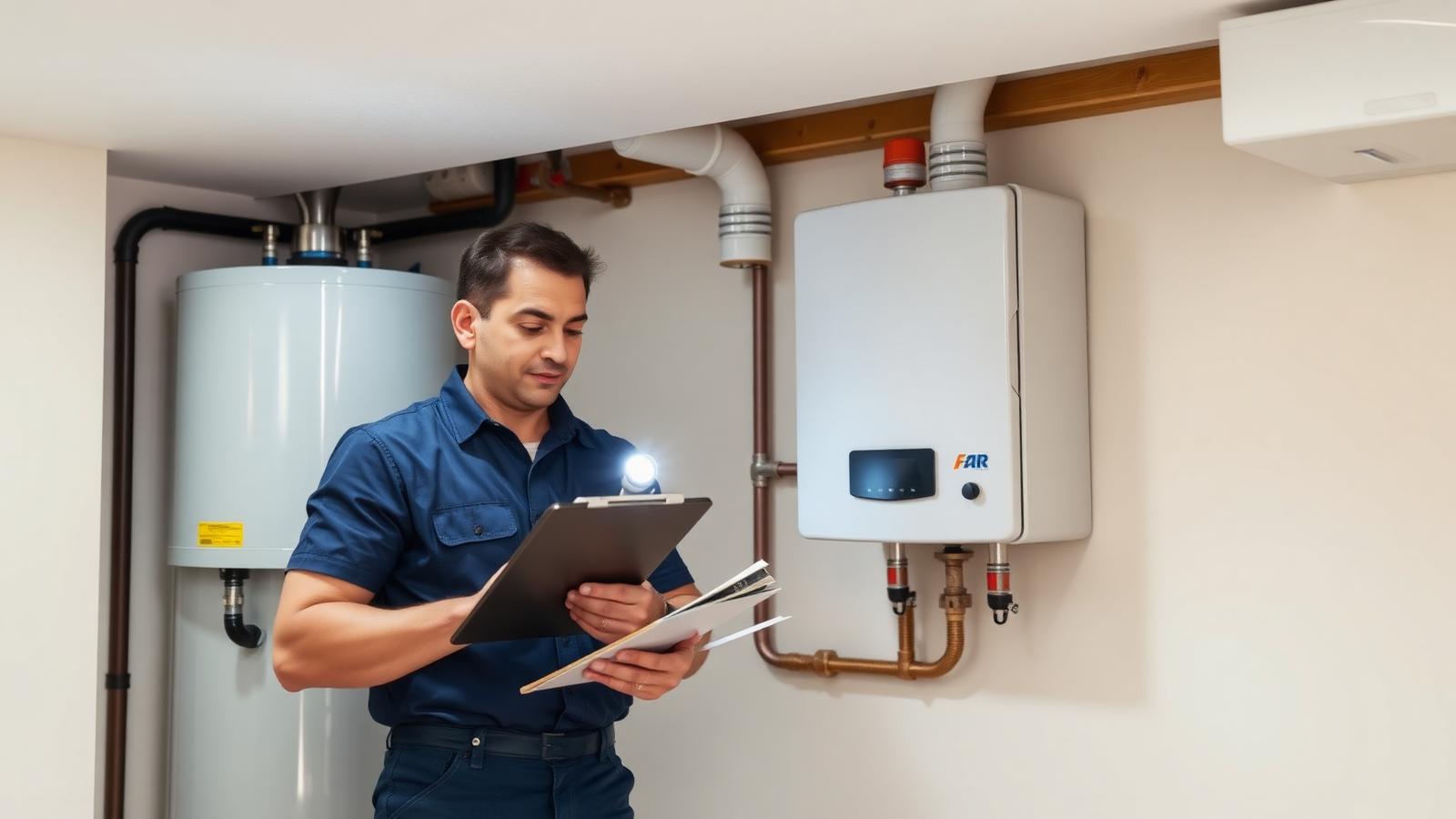
A water heater that will not heat is almost always one of five things: a tripped gas control or dead pilot, a failed electric heating element, a bad thermostat, a broken dip tube mixing cold with hot, or a tankless unit locked out on an error code. Tank repairs in the GTA run $150 to $650. Full replacement runs $1,600 to $4,200 depending on fuel type and tank vs tankless.
- No hot water at all usually means an electrical or ignition failure; lukewarm water usually means a heating element or dip tube problem, not a dead unit.
- A tank water heater older than 10-12 years with any failure symptom is a replace-not-repair decision in most GTA homes.
- Tankless units display a two- or three-digit error code on the remote or unit face - look it up before calling for service, it saves a diagnostic trip.
- Sediment buildup on a tank heater in hard GTA water areas can cut usable hot water capacity by 20-30% within five years without flushing.
- Repairs typically run $150-$650; full replacement runs $1,600-$2,400 for a standard tank and $3,200-$4,200 for tankless installed.
- Typical repair cost (GTA)
- $150 - $650
- Typical replacement cost (tank, installed)
- $1,600 - $2,400
- Typical replacement cost (tankless, installed)
- $3,200 - $4,200
- Diagnosis time on site
- 20 - 45 minutes
- Permit needed
- Yes for gas line or venting changes; not for like-for-like tank swap
- DIY vs pro
- Visual diagnosis DIY-safe; gas valve and wiring work licensed-pro only
- Typical tank lifespan in GTA water
- 8 - 12 years
Start by naming the actual symptom
"No hot water" is three different problems wearing the same name. A homeowner in Scarborough who turns the tap and gets stone-cold water within a second has a different failure than a homeowner in Oakville who gets ten minutes of warm-not-hot water that never improves, and both are different again from a homeowner whose hot water is fine for one shower and gone for the next three. Before touching anything, figure out which of these three you actually have, because it points straight at the failed part.
| Symptom | Most likely cause (tank) | Most likely cause (tankless) |
|---|---|---|
| No hot water at all, ever | Dead pilot or ignition, tripped gas valve, no power to electric elements | No power/gas supply, or unit locked out on an error code |
| Water is lukewarm, never gets hot | Failed lower heating element, thermostat set too low, broken dip tube | Undersized flow rate for the fixture, scaled heat exchanger |
| Hot water runs out fast | Undersized tank, failed upper element, cross-connected plumbing | Flow rate exceeding unit capacity, cold winter groundwater temp |
| Water is hot then suddenly cold mid-shower | Thermostat cycling fault, sediment insulating the element | Minimum flow activation dropping below sensor threshold |
| Rust-colored or metallic-tasting hot water | Anode rod fully consumed, tank corroding internally | Rare - usually a plumbing-side issue, not the unit |
Gas tank water heaters: pilot, thermocouple, and gas valve
Most GTA homes built before 2015 run a standard 40 or 50-gallon gas tank, often a rental from a utility or a third-party provider. When one of these stops heating, the fault is almost always at the bottom of the tank: the pilot light, the thermocouple or flame sensor, or the gas control valve itself.
Open the access panel at the bottom of the tank and look for the pilot flame through the sight glass. No flame means either the pilot has gone out on its own, which is common after a gas supply interruption, or the thermocouple has failed and is telling the gas valve there is no flame even when there is. A pilot that lights but will not stay lit when you release the igniter button is a thermocouple 9 times out of 10, and it is a $120-$220 part-and-labour repair in the GTA. A pilot that will not light at all, with no spark or clicking at the igniter, points to the gas control valve, which is a $280-$450 repair or, on an older unit, a reason to replace instead.
Electric tank water heaters: elements and thermostats
Electric tanks are common in rural GTA fringe areas without gas service and in some condos and townhouses. They use two heating elements, upper and lower, each with its own thermostat. This split matters for diagnosis: if the upper element fails, you get no hot water at all because the upper thermostat controls the whole tank's power in most residential wiring configurations. If the lower element fails, you get a tank's worth of lukewarm water, because the top few gallons still heat but everything below stays cold.
A homeowner can safely check this with the power fully shut off at the breaker: pull the lower access panel, and if the insulation looks scorched or the element itself is visibly caked in white or grey scale, that element has likely failed. Element replacement runs $150-$280 in the GTA including the thermostat reset. Testing with a multimeter for continuity across the element is the reliable confirmation, but that step is where we recommend calling a technician if you are not comfortable working inside a live electrical panel area.
The dip tube: an overlooked cause of lukewarm water
The dip tube is a plastic pipe that runs down the inside of the tank and delivers incoming cold water to the bottom, where it should heat before rising. A cracked or disintegrated dip tube dumps that cold water near the top of the tank instead, where it mixes directly with the hot water leaving through the outlet. The result is water that never gets properly hot no matter how long you wait, and it is frequently misdiagnosed as a thermostat problem because both produce lukewarm output.
Dip tube failure was common on tanks manufactured in the 1990s using a defective plastic formulation, and pieces of the disintegrating tube sometimes show up as small white flecks clogging faucet aerators throughout the house - that symptom, combined with lukewarm water, is close to a confirmed diagnosis. Replacing a dip tube costs $180-$320 in labour on most tank designs, and on a tank already past 10 years old it is usually bundled into a replacement decision instead.
Sediment and the anode rod: the slow failures
Hard water across much of the GTA, particularly in Peel and York Region on municipal supply, leaves mineral sediment on the tank floor over time. That layer insulates the burner or lower element from the water above it, so the heater works harder and longer to deliver the same temperature, and eventually it cannot keep up with demand at all. A tank that has never been flushed in 5+ years and is now slow to recover between uses is showing classic sediment symptoms.
The anode rod is a sacrificial metal rod that corrodes instead of the tank's steel lining. Once it is fully consumed, usually somewhere between year 4 and year 6 in GTA water, the tank itself starts corroding, which shows up as rust-tinged water or a metallic smell. Anode replacement is cheap, $120-$200, and is the single best-value maintenance item on a tank heater, but most homeowners never do it because nobody tells them it exists until the tank is already failing.
- Annual flush: drains sediment before it insulates the burner or element.
- Anode check at year 4-5: replace before it is fully consumed.
- Temperature and pressure relief valve test: lift the lever briefly once a year to confirm it releases and reseats.
- Visual check for rust or moisture at the base of the tank: early sign of tank-wall failure.
Tankless units: error codes and flow-rate limits
Tankless water heaters, increasingly common in newer GTA builds and popular as rental replacements, fail differently than tanks. They rarely just stop working silently - they display an error code on the unit or a wired remote, and that code narrows the diagnosis immediately instead of requiring the guesswork a tank demands.
| Common tankless error | Typical cause | Homeowner action |
|---|---|---|
| 11 / ignition failure | Gas supply interrupted, closed valve, or ignition component fault | Confirm gas valve is fully open, reset once, then call for service |
| 12 / flame failure during operation | Flame sensor fouled, or venting restriction | Check exterior vent termination for snow or ice blockage |
| 029 / fan or combustion issue | Blocked intake or exhaust, common after a windstorm or snowfall | Clear visible obstructions at exterior vent cap only |
| 05 / freeze or thermal fault | Exposed piping froze in an unheated space during a cold snap | Add insulation, do not attempt to thaw with an open flame |
| Water only lukewarm, no error code | Flow rate exceeds unit's rated capacity at winter groundwater temp | Reduce simultaneous fixture use, or confirm unit sizing with a pro |
Scale buildup inside the heat exchanger is the tankless equivalent of tank sediment. Areas with harder water need the unit descaled with a vinegar or manufacturer-approved solution flush annually; areas on softer municipal supply can often stretch to every 18-24 months. A neglected heat exchanger restricts flow and trips high-limit safety codes long before it fails outright, so recurring error codes on a unit over three years old with no flush history point straight at scale.
Rental vs owned units in the GTA
A large share of GTA tank water heaters are rented from a utility-affiliated provider rather than owned outright. If your unit is a rental, check your rental agreement before paying for any repair - most rental contracts include parts and labour for exactly the failures described in this article, and calling your provider's service line first can mean a no-cost fix instead of an out-of-pocket bill. Owned units, and any tankless system, are the homeowner's responsibility for repair and eventual replacement, which is where the repair-vs-replace math below matters.
Repair vs replace: the real cost comparison
| Situation | Typical GTA cost | Recommendation |
|---|---|---|
| Thermocouple or ignitor failure, tank under 8 years old | $120 - $220 | Repair |
| Single heating element failure, tank under 8 years old | $150 - $280 | Repair |
| Gas control valve failure, tank 8-12 years old | $280 - $450 | Repair if under 10 yrs, otherwise replace |
| Dip tube replacement, tank 6-10 years old | $180 - $320 | Repair |
| Tank leaking from the tank body itself | Not repairable | Replace - $1,600 - $2,400 installed |
| Tankless recurring error codes with no flush history | $180 - $350 descale + repair | Descale first, replace if over 12 years old |
| New standard gas tank, 40-50 gal, installed | $1,600 - $2,400 | - |
| New tankless unit, installed with venting | $3,200 - $4,200 | - |
A safe homeowner diagnosis sequence
Here is the order we walk through on a real GTA service call, written so you can safely do the first several steps yourself before deciding whether to call a technician.
- Confirm power and fuel supply: check the breaker for an electric unit, and confirm the gas valve is in the fully open position for a gas unit.
- Identify the exact symptom: no hot water, lukewarm water, or hot water that runs out fast, using the table at the top of this guide.
- For gas tanks, check the pilot through the sight glass: lit and steady, lit but won't stay lit, or no flame and no click at the igniter.
- For electric tanks, note whether the whole tank is cold (points to the upper element) or only partly warm (points to the lower element), with power off before opening any panel.
- For tankless units, read the error code on the display or remote and check the exterior vent termination for snow, ice, or debris blockage.
- Check the tank's age from the manufacture date on the rating plate; anything past 10 years changes the recommendation toward replacement.
- Look for visible rust, moisture, or corrosion at the tank base, which indicates the tank itself has failed regardless of any other symptom.
- If the unit is a rental, call the rental provider's service line before booking independent repair, since many failures are covered at no cost.
When to stop and call a professional
Gas valve, thermocouple, and any work involving the flue or venting connection on a gas unit should be done by a TSSA-licensed gas technician - this is a code requirement in Ontario under CSA B149.1, not just a safety suggestion. Electrical element and thermostat work inside a live panel is safe to inspect visually with the power off, but wiring diagnosis with a multimeter is best left to a licensed technician if you are not already comfortable with basic electrical testing. Any sign of active leaking from the tank body means shutting off the water supply and power or gas immediately and arranging same-day replacement, since a fully failed tank can release 150+ litres onto a basement floor.
Straight answers
Short, sourced answers to the questions GTA homeowners ask most about this topic.
Why is my water heater not producing hot water at all?
A water heater producing zero hot water almost always has a total loss of ignition or power at the heat source. On a gas tank, the pilot light or thermocouple has failed, or the gas control valve will not open. On an electric tank, the upper heating element has failed, cutting off the circuit that controls the whole tank. On a tankless unit, gas or power supply has been interrupted, or the unit has locked out on an error code.
Why does my water heater only produce lukewarm water?
Lukewarm water from a tank water heater points to a failed lower heating element, a thermostat set too low, or a cracked dip tube letting cold water mix directly with hot at the outlet. Lukewarm water from a tankless unit usually means the flow rate demanded by open fixtures exceeds the unit's rated capacity, which is more common in the cold Ontario winter months when incoming groundwater temperature drops.
How much does it cost to repair a water heater in the GTA?
Water heater repairs in Toronto and the GTA typically run $150 to $650 depending on the part. A thermocouple or ignitor repair costs $120-$220, a heating element replacement costs $150-$280, and a gas control valve replacement costs $280-$450. Repairs above roughly half the cost of a new unit are usually not worthwhile on a tank older than 8 years.
How do I know if my water heater needs to be replaced instead of repaired?
A water heater needs replacement rather than repair when the tank itself is leaking, when it is older than 10-12 years and a major component fails, or when the repair cost exceeds roughly half the price of a comparable new unit. A tank showing rust-colored water or visible corrosion at the base has already failed structurally and cannot be repaired.
What does a tankless water heater error code mean?
A tankless water heater error code identifies a specific fault such as ignition failure, flame loss, blocked venting, or a freeze condition, displayed as a two- or three-digit code on the unit or wired remote. Looking up the exact code against the manufacturer's chart before calling for service narrows the visit to the actual problem instead of a general inspection.
How does cold Ontario winter weather affect tankless water heaters?
Cold Ontario winters lower incoming groundwater temperature to roughly 4-6 C, compared to 12-15 C in summer, which forces a tankless water heater to work harder for the same output temperature and can reduce its usable flow rate by 20 to 30 percent. A tankless unit that runs two showers comfortably in summer may only support one shower reliably in February.
What is a dip tube and how does it cause lukewarm water?
A dip tube is the internal pipe inside a tank water heater that carries incoming cold water to the bottom of the tank so it heats before rising to the outlet. When the dip tube cracks or disintegrates, cold water is released near the top instead and mixes directly with the outgoing hot water, producing lukewarm output regardless of how long the heater runs.
Should I call a professional or troubleshoot my water heater myself?
Homeowners can safely check breaker status, gas valve position, pilot flame visibility, and tankless error codes without tools. Any work involving the gas valve, thermocouple, venting, or internal electrical wiring should be done by a TSSA-licensed gas technician or qualified electrician, since these components are regulated under CSA B149.1 and carry real safety risk if handled incorrectly.
60-minute callback. No obligation. GTA-wide.
Frequently asked questions
Can I flush my own water heater tank?
Yes, on most tanks this is a straightforward homeowner task: shut off the power or gas, connect a hose to the drain valve, and run it until the water clears. Skip it if the drain valve looks corroded or seized, since forcing a stuck valve can cause a leak that requires a plumber anyway.
Why does my water heater make popping or rumbling noises?
Popping or rumbling almost always means sediment buildup on the tank floor. Water trapped under the sediment layer boils and escapes in small bursts, creating the noise. It is not dangerous in the short term but signals the tank needs flushing soon.
Is it normal for a tankless unit to take longer to deliver hot water than a tank?
Yes, a small delay is normal because a tankless unit has to detect flow and ignite before heating begins, versus a tank that already holds hot water ready to go. A recirculation pump can be added to eliminate this wait if it bothers you.
How do I find out how old my water heater is?
The manufacture date is encoded in the serial number on the rating plate, usually near the top of the tank or on the tankless unit's side panel. Most manufacturers use the first two digits as the week and year, though formats vary by brand.
What size tankless unit does a typical GTA home need?
Most three- to four-bedroom GTA homes need a mid-to-high output tankless unit rated for roughly 8-10 GPM at a 60 degree F rise to run two fixtures simultaneously through winter groundwater temperatures. Undersizing is the most common installation mistake we see on replacement calls.
Does homeowner's insurance cover a leaking water heater?
Most Ontario homeowner policies cover the sudden water damage from a tank failure but not the cost of the tank itself, since that is considered mechanical failure or wear. Check your specific policy wording, as coverage for the appliance itself varies between insurers.
Can hard water damage a tankless water heater faster than a tank?
Yes, scale forms on the narrow heat exchanger passages inside a tankless unit faster than on the open floor of a tank, which is why annual descaling is a stronger requirement for tankless systems in hard-water areas of the GTA than tank flushing is for tanks.
Should I replace a rented water heater myself?
No, a rented unit belongs to the rental company and unauthorized modification or replacement can void your rental agreement and leave you liable for the removed equipment. Contact the rental provider directly for any replacement decision.
What temperature should my water heater be set to?
60 C (140 F) is the standard recommendation to prevent bacterial growth while limiting scald risk, though many GTA homes run 49-54 C (120-130 F) at the tank with a mixing valve for safety at the tap. Never set below 49 C, as it allows legionella growth.
Written by The Diamond Home Services Team — Water heater diagnosis and replacement specialists - Toronto & the GTA. Last fact-checked .
- CSA B149.1 — Natural Gas and Propane Installation Code, applies to gas water heater service in Ontario
- TSSA — Technical Standards and Safety Authority - Ontario's gas technician licensing body
- Ontario Building Code — Governs venting, permit requirements, and installation clearances for water heaters
- Natural Resources Canada — EnerGuide water heater efficiency and sizing guidance
Book this service in your area
Keep reading
- Dryer VentDryer Vent Cleaning Cost in Toronto & the GTA (2026 Prices)
A straight answer on dryer vent cleaning prices in the GTA, what makes one quote $149 and the next $399, and the questions that stop an upsell before the van arrives.
- SeasonalWinter Home Safety: The 20-Point GTA Pre-Season Checklist
Twenty specific checks, in the right order, between September and November, so your chimney, furnace, water heater and roof are ready before the first cold snap hits the GTA.
- Homeowner GuideDo I Need a Permit? GTA Rules for Chimney, Roof and Venting Work
A clear answer to whether your roof, chimney or venting project needs a municipal permit or a TSSA-registered contractor, with real fee ranges and the resale risk of skipping the paperwork.